
I was expelled from Texas on the same day that Mom was diagnosed with terminal bone cancer. This was in early December 2001. (Worse day of my life, that one.) The following semester I registered as an undergraduate while appealing the dismissal. One of my favorite classes of that whole sordid grad school fiasco was a class I took in the spring of 2002 on Science and Technology in Antiquity by Dr. Riggins in the History Department.
I wrote a couple of nice reports for that class that I later bundled into a “Sith Lite” sci-fi context (the evil characters of the Star Wars saga) as The Praetorian Guard. One of the papers was on Roman aqueducts and another on the mystical reverence the Romans had for stone and stone construction. (The Temple to Mars in Rome has a giant hole in the middle; to this very day, we can’t duplicate that hole – not with reinforced concrete, rebar, nada. . . )

Toward the end of that semester, I chanced on a copy of Graham Hancock’s Fingerprints of The Gods. This was one of those crazy “aliens built all the ancient monuments” kind of books. It seemed like a fad at the time, but they sure took over The History Channel post haste.

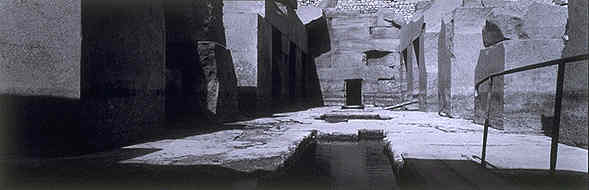
One structure described in that book intrigued me, called The Osireion at Abydos. (The pages from Fingerprints of the Gods.) The Swiss Egyptologist Henri Naville, who discovered the place circa 1914, published an article in The London Times, saying he believed The Osireion (and The Sphinx) was 5000 years older than the earliest artifacts in Ancient Egypt. This date has since been proven by geological dating (more on that later).

As you can see from the images, The Osireion is underground. It’s a very elegant structure with giant megalithic stones. No other structure in all of Antiquity has this kind of structure, with the possible exception of a small temple near the Sphinx. The Osireion is built so that a central pool of water (and pools around the perimeter columns – the darker areas around the outside of the columns in the photo above) are at exactly the water table of the nearby Nile River.

I checked out the original musty old documents published by The Egypt Exploration Society (by Naville and Madalene Murray – her book) from the Perry Castaneda Library at Texas that summer 0f 2002. They were recalled almost immediately! I mean, practically before I got home to Lago Vista. I copied what I needed and returned the volumes. They were never returned to the public stacks.
I would have dropped the whole thing if they hadn’t done that. But as it was, how could I not ask, “What the F did they do that for?”

The Osireion is directly adjacent to the Temple of Seti I (the pharaoh of Moses and the Ten Commandments, where he turned the Nile River blood red) as you can see from this areal photo.

I hatched a theory about The Osireion (which became the central theme of my screenplay Kharga Doom), trying to explain the age. Which really is 10,000 years old (5,000 years older than the first step pyramids). The proof is in “water wash” patterns, which could only have been made from exposure to regular, steady rain. And Egypt hasn’t had that kind of precipitation for 10,000 years.

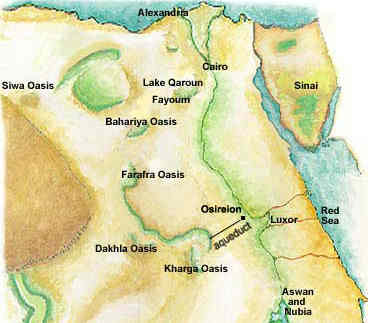
10,000 years ago, the Sahara was a lush tropical region just like the Amazon in Brazil is now. Then the rains stopped, and only a few oases remained (in the shape of a “Fertile Crescent”). My theory was that The Osireion was a “castellum,” which is the very beginning of Roman aqueducts, where multiple wells drilled deep into the ground provide a large volume of water. (The seven aqueducts to ancient Rome supplied more water than the entire metropolis uses in the modern day.)

Why would they build this castellum – right there next to the Nile River, at the level of the water table – with guaranteed, steady access to water?? (Well, evaporative cooling during the Egyptian era made it a very popular stop on the Forty Days Caravan Route back then – Cairo south to Namibia; the Greek geographer Strabo visited there in the Roman era, after which it was called “Strabo’s Well,” then lost until the modern era.) My theory was the original structure was built to send water inland via an underground aqueduct to the Grand Oasis at Kharga (still an oasis in the modern day) to keep the city alive as the tropical paradise dried up. Here’s a map I made:
My screenplay Kharga Doom (later called Kharga Dune) was about an outfit drilling for oil in the Kharga area (LOTS of oil around there), tapping into ancient soils that had microscopic red algae (which can cause hallucinations) – a curse! – but, back then, something that could turn the Nile Red and cause all the other nine plagues as hallucinations.
The above photos show no writing on the walls. It’s all worn off because of weathering since 1914. However, the original Osireion – when they first found it underground – had lots of inscriptions. One of the original sections of my website back then, The Texas X Files, was an analysis of these inscriptions. I’ve loaded all those pages into this PDF file. This series of formal tech papers explains what we’ve talked about, leading into the inscriptions (which were in the documents the library recalled ASAP).
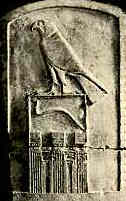
Biblical scholars generally believe Moses wrote the Book of Job, about the lone survivor of an ancient civilization wiped out by – climate change? I take this to the somewhat circumspect conclusion: that civilization was at Kharga.
With all due respect to Moses, personally, I think the Ten Plagues were a clever trick using basic chemistry science (which back then was voodoo magic) to fool the Pharaoh into releasing the Hebrew slaves. Why he didn’t get the Egyptian slaves released too is a matter for debate. In Kharga Doom, they discover this algae and; well, it drives everybody – loco!
So, there you have it. A nice theory about ancient origins. Sure it’s a stretch, but – hey, we all came from somewhere – why not make it a nice place?
Years later I re-wrote the Book of Genesis. The Hebrews, by their own admission, destroyed Babylon as a “temple to the heathen gods.” Any time engineered structures are destroyed; well I take immediate offense. Hence, I rewrote Genesis (and then ALL the books of Moses, in the Torah – I’d given the Book of Job a complete makeover back in 1980) to make Esau the new hero (he was the Hebrew’s arch-villain). I’ll add that book here later on. The other books are still handwritten in notebooks.
The engineer tech folks who built the Hanging Gardens of Babylon? According to my Genesis 2.0, they ended up in the Italian peninsula, alias the Etruscans, building Rome. Where are they now?
Hmmmm . . . .